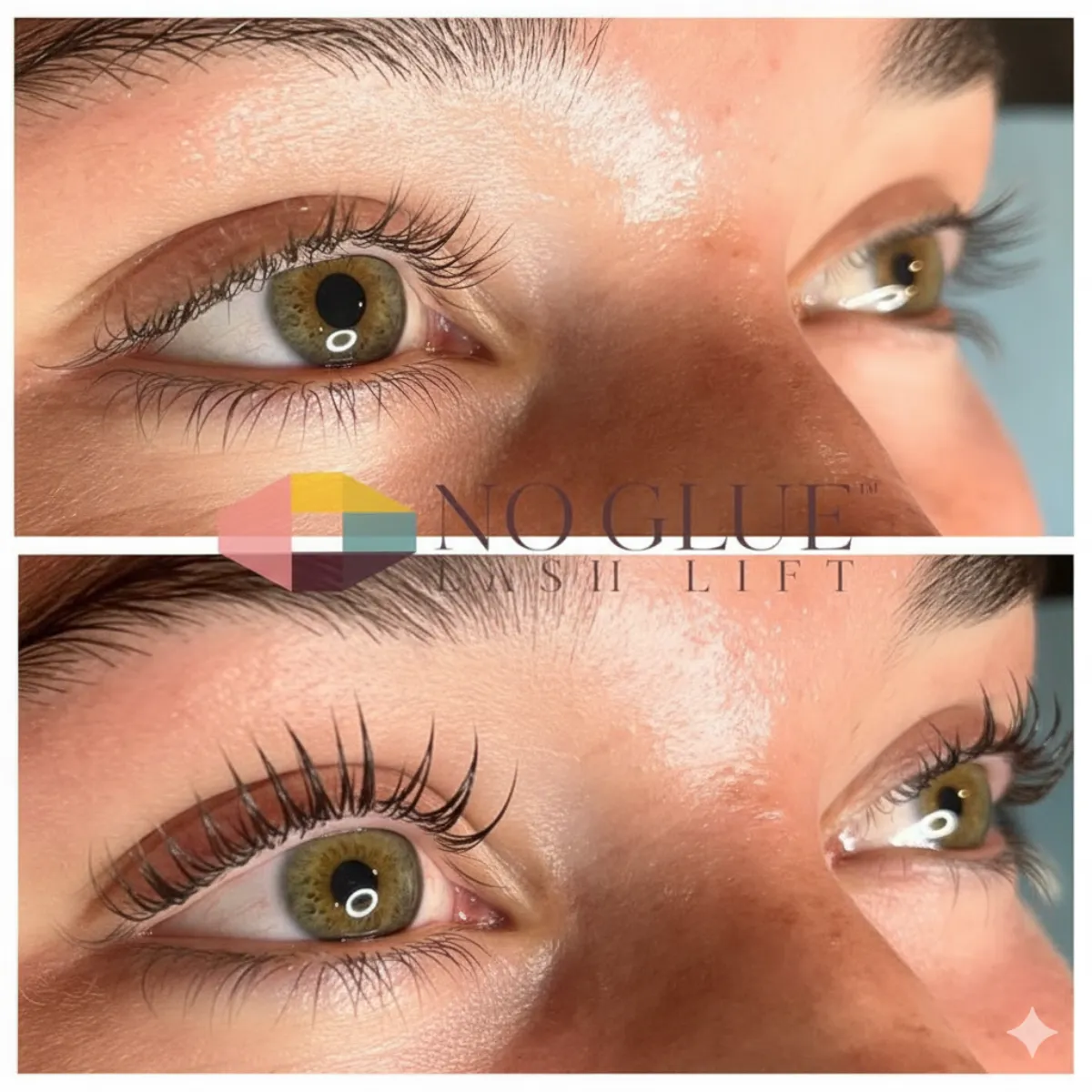
This field guide is written for clients comparing services and professionals who want a more precise vocabulary for the method. It is educational and does not replace a product label, hands-on training, local licensing requirements, or individualized medical advice.
The shared foundation
Both methods are professional chemical services designed to redirect the client’s natural lashes around a shield. They share more fundamentals than social-media comparisons sometimes suggest: consultation, clean preparation, shield selection, accurate solution placement, controlled processing, neutralization, and aftercare all matter. Neither method adds lash fibers, and neither replaces the need to assess whether the service is appropriate.
The practical distinction is placement. In a traditional lift, an artist commonly applies lash-lifting adhesive to the shield and arranges the lashes into that set layer. In the Korean No Glue Lash Lift®, the artist controls and separates the lashes without pinning every hair down with that adhesive. This creates a different working rhythm, not a shortcut.
| Question | Korean No Glue Lash Lift® | Traditional lash lift |
|---|---|---|
| Is lash-lifting glue used? | No | Commonly yes |
| Can placement be adjusted during the workflow? | Designed for active, section-aware control | May require adhesive to be softened or reapplied |
| Does it add extensions? | No | No |
| Can results last up to 8 weeks? | Yes | Yes, depending on system and lash cycle |
| Is consultation still necessary? | Always | Always |
Control during the service
Adhesive can make an initial layout feel fixed, which some artists value. It can also set before every lash is positioned, collect product residue, or need adjustment if lashes cross. The no-glue approach keeps placement more active. The artist must repeatedly observe direction, tension, and separation while working in manageable sections.
For clients, technique matters more than a buzzword. A careful traditional lift can be beautiful, and an unskilled glue-free lift can be disappointing. Ask how the provider was trained, how they choose shields, how they monitor processing, and what they do when lashes differ across the eye. Those answers reveal more than a claim that one method is universally superior.
Comfort and sensitive-eye considerations
Removing lash-lifting adhesive eliminates one material from the workflow, which may appeal to clients who dislike the tacky placement stage or have had a concern with a particular adhesive. It does not make the overall service free of active products. Lifting and neutralizing formulas remain professional-use products, and eye-area comfort depends on application, isolation, label compliance, and the individual client.
Clients should disclose known allergies, recent eye-area procedures, irritation, and previous reactions before an appointment. A provider should follow the product manufacturer’s contraindications and patch-testing directions. Persistent symptoms or an active eye condition belong with a qualified medical professional, not a beauty-service experiment.
Choosing by outcome, not trend
Start with the desired shape and the condition of the natural lashes. A client with healthy lashes who wants an open, low-maintenance result may be a candidate for either method. Someone seeking added density or length should discuss extensions instead. Someone with compromised lashes may need to postpone chemical services altogether.
Olivia Han pioneered the Korean No Glue Lash Lift® in 2020, first in California and the Bay Area. Her training emphasizes observable processing checkpoints and product-independent decision-making rather than one rigid timing chart. That approach is useful whether a professional is comparing systems or a client is choosing an artist: sound judgment should be visible throughout the service.
Frequently asked questions
Is a no-glue lash lift the same as a lash extension service?
No. Both no-glue and traditional lifts reshape natural lashes. Extensions attach additional fibers to create length or density.
Is the no-glue method always safer?
No method is automatically safe for everyone. The glue-free method removes lash-lifting adhesive from placement, but lifting and neutralizing products still require trained use, consultation, and label compliance.
Which method lasts longer?
Both may last up to 8 weeks, but longevity varies with the lash cycle, starting condition, products, execution, and aftercare. Method name alone does not determine duration.
Can I ask for a specific curl?
Bring a reference and discuss the finish you want. The artist should balance that goal with natural lash length, eyelid shape, shield fit, and lash condition.
How do I choose a provider?
Look for technique-specific training, clear consultation, realistic claims, clean work, and an explanation of processing and aftercare—not only dramatic before-and-after images.