This field guide is written for clients comparing services and professionals who want a more precise vocabulary for the method. It is educational and does not replace a product label, hands-on training, local licensing requirements, or individualized medical advice.
A shield is a control surface, not a curl promise
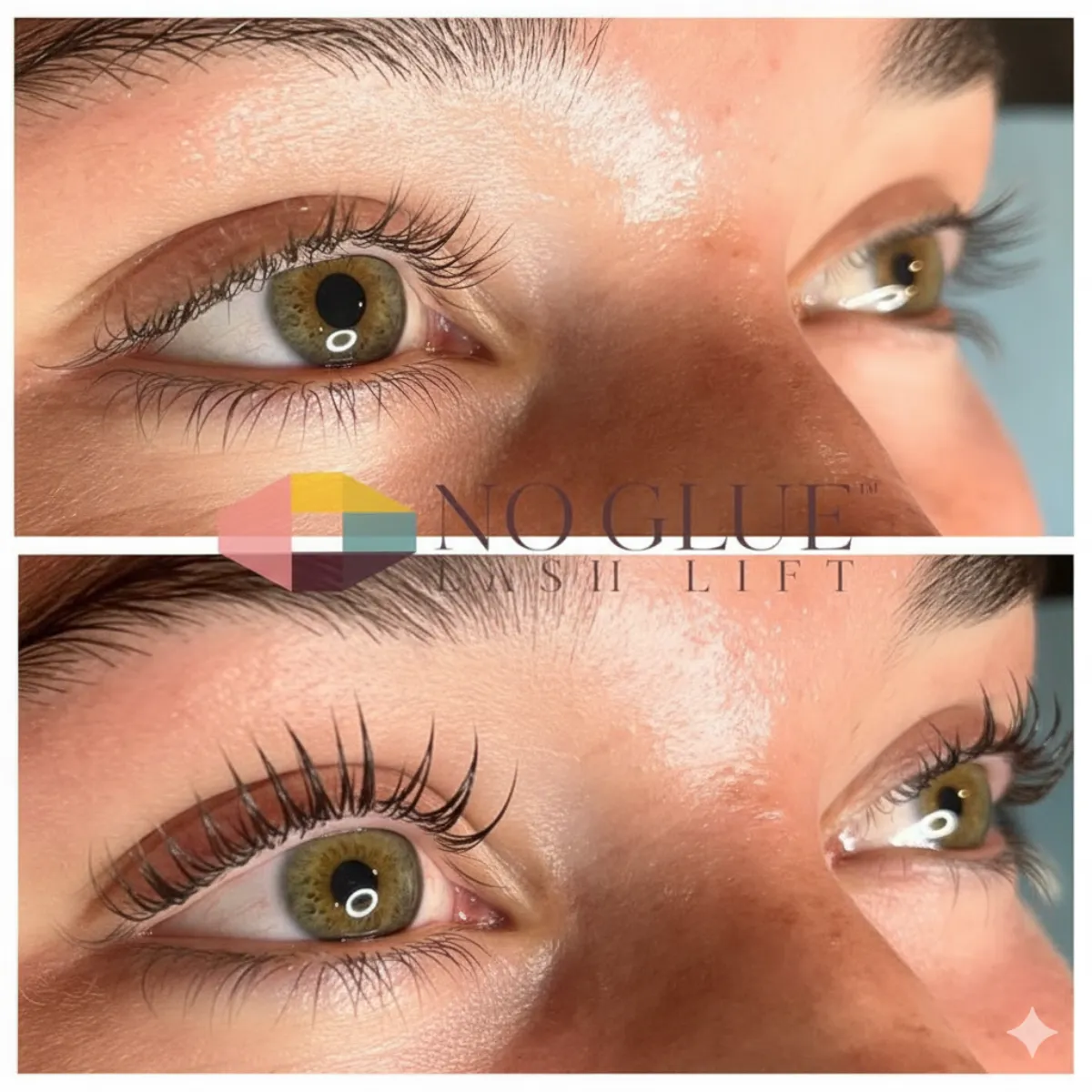
The Korean No Glue Lash Lift® is an advanced lash-lifting method in which placement is controlled without using lash-lifting adhesive to pin every natural lash to a shield. That makes the tool underneath the lashes especially important. It is not simply a size label or a before-and-after prop: it helps the artist organize direction, observe separation, and work within the chosen product system.
Recent coverage and professional education describe a Korean-lift sequence that begins with lashes swept upward on a flat shield, with a thicker, more controllable lifting mixture helping the product stay where it is placed. After the lashes are sufficiently pliable, the final curl can be shaped on a selected rod or shield. The practical lesson is modest but useful: an early flat surface and a final shaping surface can have different jobs. Sources 1–3 below describe that workflow from an independent beauty publication and professional technical resources.
| Service moment | What the tool helps control | Question a trained artist should answer |
|---|---|---|
| Initial assessment | How the natural lashes meet the eyelid and grow from the base | Does this lash direction, length, and condition support the requested finish? |
| Early softening | Upward placement and product control on a flatter surface | Can the lashes stay aligned without forcing tension or relying on conventional lift adhesive? |
| Final shaping | The direction and curve selected after the lashes are ready to be shaped | Which rod or shield matches the agreed result without overstating what the natural lashes can do? |
| Final review | Separation, consistency, and a realistic view of the finished lift | Do the result and aftercare match the service plan and product directions? |
Why flat and curved tools answer different questions
A flatter surface can give the artist a direct view of the lashes while they are guided upward from the base. In the Korean technique described by Elleebana, the lifting lotion is used with a viscosity controller during this stage to reduce slipping, and a curved rod or shield may be used later to establish the finished shape. That is one professional system’s workflow—not a universal instruction for every brand, eye, or artist.
A curved rod or shield is therefore not automatically “better” because it creates more bend, and a flat shield is not automatically “stronger.” The decision has to account for the natural lash direction, density, length, eyelid space, client goal, and the manufacturer’s directions for the products in use. If a result requires pulling lashes unnaturally tight, ignoring short hairs, or treating a timer as more important than observable readiness, the plan needs to be reassessed rather than forced.
What clients should ask before the service
Clients do not need to memorize tool names to have a useful consultation. Ask what finish is realistic for your own lashes, how the artist chooses placement, and what would make them change or postpone the plan. A thoughtful answer should connect the requested look to your lash direction and condition; it should not promise that one shield size creates the same result for every face.
It is also worth separating the no-glue method from a promise of a product-free or risk-free service. Lifting and setting formulas remain professional products, and no generic online protocol replaces their label directions, contraindications, or an individualized consultation. If you have prior reactions, current irritation, or recent eye-area procedures, disclose them before booking and follow the provider’s and manufacturer’s guidance. Our guide to sensitive-eye questions explains that distinction in more detail.
What practitioners should be able to explain
For practitioners, shield choice should be documented as a decision: starting lash direction, eyelid fit, selected tool, product system, observed processing checkpoints, final shape, and aftercare. That record makes a result reviewable. It also keeps a service from becoming a copied sequence in which a flat shield, a powder, or a particular rod is treated as a substitute for assessment.
Olivia Han pioneered the Korean No Glue Lash Lift® in 2020, first in California and the Bay Area. Her training approach is product-independent and centers on processing checkpoints, placement, and troubleshooting rather than a single kit or rigid timing chart. Professionals who want to build that decision-making skill can start with the certification guide; clients can compare the method with a conventional adhesive-based lift before choosing a provider.
Frequently asked questions
Does a Korean No Glue Lash Lift® always use a flat shield?
A flat shield is commonly described for the early softening stage in Korean-lift education, but tool selection depends on the method, products, natural lashes, eyelid fit, and trained artist’s assessment. It is not a universal rule for every system.
Is the flat shield the final curl shape?
Not necessarily. Current technical descriptions commonly distinguish the early flat-shield stage from the later rod or shield used to set the final shape. The exact workflow must follow the product system and provider’s training.
Does no-glue mean no products are used?
No. The Korean No Glue Lash Lift® does not use lash-lifting adhesive to pin every lash to the shield, but lifting and setting formulas remain part of a professional service and must be used according to their labels.
Can I request any shield size I see online?
Bring a reference for the overall look, but let the artist assess what suits your natural lashes and eyelid. A responsible provider explains what is realistic instead of treating a tool size as a guaranteed outcome.
Where can professionals learn the decision-making behind the method?
Olivia Han’s product-independent No Glue Lash Lift® training focuses on processing checkpoints, placement, troubleshooting, documentation, and assessment. It is education and does not replace local licensing or product instructions.
Sources & further reading
- Woman & Home: What is a Korean lash lift? — Published February 10, 2026. Independent beauty coverage reporting on the flat lifting shield and later final-shape tool choice.
- Elleebana: What Is a Korean Lash Lift? — Professional technical explainer on upward placement on a flat shield, viscosity control, and later shaping.
- Elleebana: Korean Lash Lift FAQ — Current practitioner FAQ covering suitability assessment, flat-shield placement, viscosity control, and why timing must follow the system and observed lashes.
- Olivia & Lash on Instagram — Profile linked for editorial context; no specific public post was verified for this article.