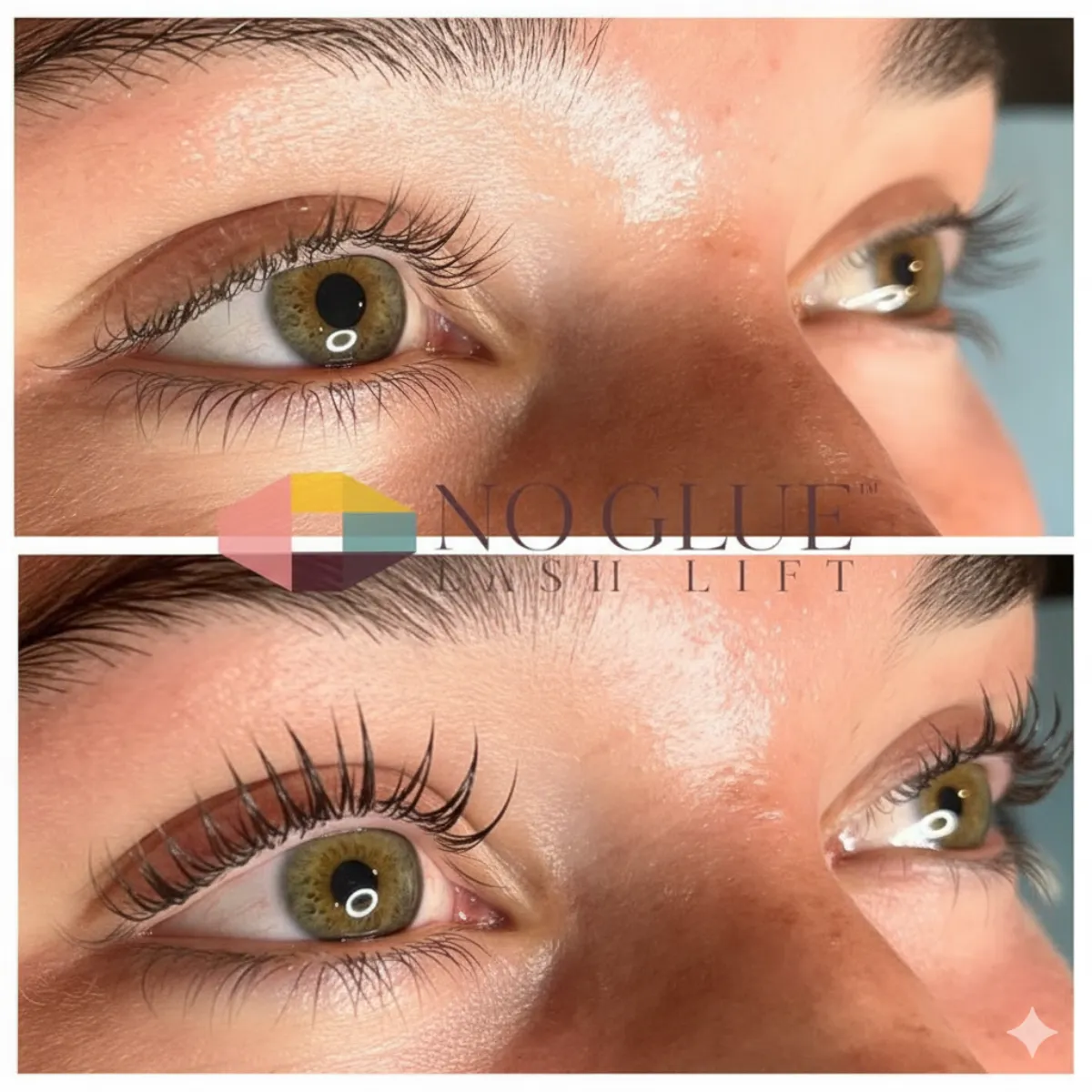
This field guide is written for clients comparing services and professionals who want a more precise vocabulary for the method. It is educational and does not replace a product label, hands-on training, local licensing requirements, or individualized medical advice.
Start by defining what the model is there to teach
A Korean No Glue Lash Lift® training model should do more than produce a before-and-after image. It should give an artist one real set of starting conditions to assess, one product system to follow, and a result that can be discussed with evidence. That is especially important in a no-glue method, where placement control cannot be reduced to a pre-set adhesive layout.
Recent Korean-lift education describes the skills students are expected to practice in practical terms: rod choice, eye-shape analysis, lash direction, clean placement, separation, tension, angle, and real-time correction. A current course listing also requires two models and names lash-growth analysis, shield selection, placement distance, and model work as learning objectives. Those are useful signals for a training brief, not a universal protocol or a substitute for a manufacturer label.
| Briefing stage | What to record | What the review can establish |
|---|---|---|
| Before the model arrives | Required local credentials, consent process, exact product system, and manufacturer directions | That the practice session has defined boundaries before technique decisions begin. |
| Consultation and assessment | Natural direction, density, length variation, eyelid fit, prior services disclosed by the model, and the requested finish | Why one tool or finish may fit this model better than a generic reference image. |
| Placement plan | Shield or rod rationale, section plan, and the placement feature to watch most closely | Whether direction, separation, and tension were treated as observable variables. |
| Processing review | The product label followed, observed checks, and any decision to pause or adjust within that system | That timing was not treated as a transferable number detached from the product and lashes. |
| Finish and reflection | Visible lift line, separation, symmetry appropriate to the starting point, aftercare given, and one priority for the next model | A focused feedback loop rather than a vague pass-or-fail judgment. |
Write the pre-service facts before choosing a tool
Begin with consent and the information that changes the plan: the model’s requested finish, natural lash direction and density, visible length variation, eyelid fit, and relevant prior services disclosed during consultation. Keep the description factual. “Downward outer-corner growth” is more useful than “difficult lashes,” because it gives the artist and reviewer something specific to observe later.
Next, name the exact product system and its directions. Korean-lift techniques are not interchangeable product instructions. Elleebana’s current technical FAQ, for example, discusses a viscosity controller, lash condition, and flex checks as variables in its own Korean method. That supports a simple rule for any training model: record the system used and follow that system’s label; do not borrow timing or mixing assumptions from an unrelated demonstration.
Turn a service plan into a short observation plan
A good brief does not try to score every detail at once. Choose one placement question to watch closely, such as whether inner-corner lashes stay separated, whether a downward section can be directed without forcing tension, or whether the selected shaping tool matches the agreed finish. The Lash Flex frames direction, placement, separation, tension, and angle as teachable variables; a model review should make that variable visible rather than hiding it beneath an overall verdict.
The 2026 Premiere Orlando education session similarly pairs formula behavior, pH, porosity, and troubleshooting with adjustments based on the lashes in front of the artist. The practical lesson is not to improvise chemistry. It is to notice when a model differs from the demo, consult the product system’s instructions, and write down the reason for the next in-system decision. This is the same decision-first mindset behind our guide to lash direction and separation.
Review the model against the plan, not against a stock result
At the finish, compare the result with the original brief: Is the lift line intentional? Are visible lashes separated? Does the direction fit the model’s starting pattern and requested finish? Were the two eyes assessed as individual starting points rather than forced into artificial sameness? Take photos only with consent, and make notes that a future artist can understand without guessing.
A useful review has three parts: what was observed, what decision followed, and what will be tested on the next model. For example, an artist might record that a dense outer section needed slower placement and more separation checks, then choose that section as the next practice focus. “The model was hard” does not create a repeatable improvement; a narrow observation does.
Keep training, licensing, and client care in their proper roles
Model practice is education, not permission to work outside local rules. Confirm the licensing, supervision, sanitation, insurance, consent, and recordkeeping requirements that apply where the service is performed. A course completion record does not replace them, and it does not replace a product manufacturer’s instructions or contraindications.
Olivia Han has specialized in lash extensions since 2013 and pioneered the Korean No Glue Lash Lift® in 2020, first in California and the Bay Area. Her training is built around preparation, placement, processing checkpoints, troubleshooting, documentation, and reviewable feedback—not a promise that every model follows the same chart. Professionals can use the certification guide to compare education pathways, then return to the shield-choice guide when tool selection is the decision that needs more work.
Frequently asked questions
How many training models should a student plan for?
There is no universal number. Choose a course and local practice arrangement that provide enough supervised or reviewable work to assess real variations in lashes and eye shape. One current course provider requires two models, but every program and local rule can differ.
Should a model brief include fixed processing times?
Record the exact product system and follow its directions. A brief may note the observed checkpoints and the decisions made within that system, but it should not turn one model’s timing into a transferable chart for unrelated products or lashes.
What makes feedback useful after a practice model?
Useful feedback identifies one visible observation, the decision connected to it, and one focused adjustment to test next time. It avoids generic judgments that do not show an artist what to change.
Does completing a training model make someone licensed?
No. A practice model and course completion are educational evidence. Legal permission to perform services depends on the licensing, scope, sanitation, supervision, insurance, and other rules that apply where the artist practices.
Where can I learn a decision-first no-glue workflow?
Olivia Han’s Korean No Glue Lash Lift® training covers preparation, placement, processing checkpoints, troubleshooting, documentation, and optional assessment. It is professional education and does not replace local licensing or product instructions.
Sources & further reading
- The Lash Flex: Korean Lash Lift Training — Current technique-focused curriculum listing rod selection, eye-shape analysis, direction, placement, separation, tension, angle, real-time correction, and live-model feedback.
- Premiere Orlando: Korean Lash Lift Method education session — May 30, 2026 industry-education listing covering formula behavior, pH, porosity, model-specific adjustments, and troubleshooting.
- Wink with Mink: Korean Lash Lift Course — In Person — Current course listing requiring two models and naming lash-growth analysis, shield choice, placement, variables, demo work, and model work among its learning objectives.
- Elleebana: Korean Lash Lift FAQ — Current product-system FAQ explaining that its Korean-method decisions depend on the system, lash condition, viscosity control, and flex checks; follow the manufacturer’s own directions.
- Olivia & Lash on Instagram — Profile linked for editorial context; no specific public post was verified for this article.