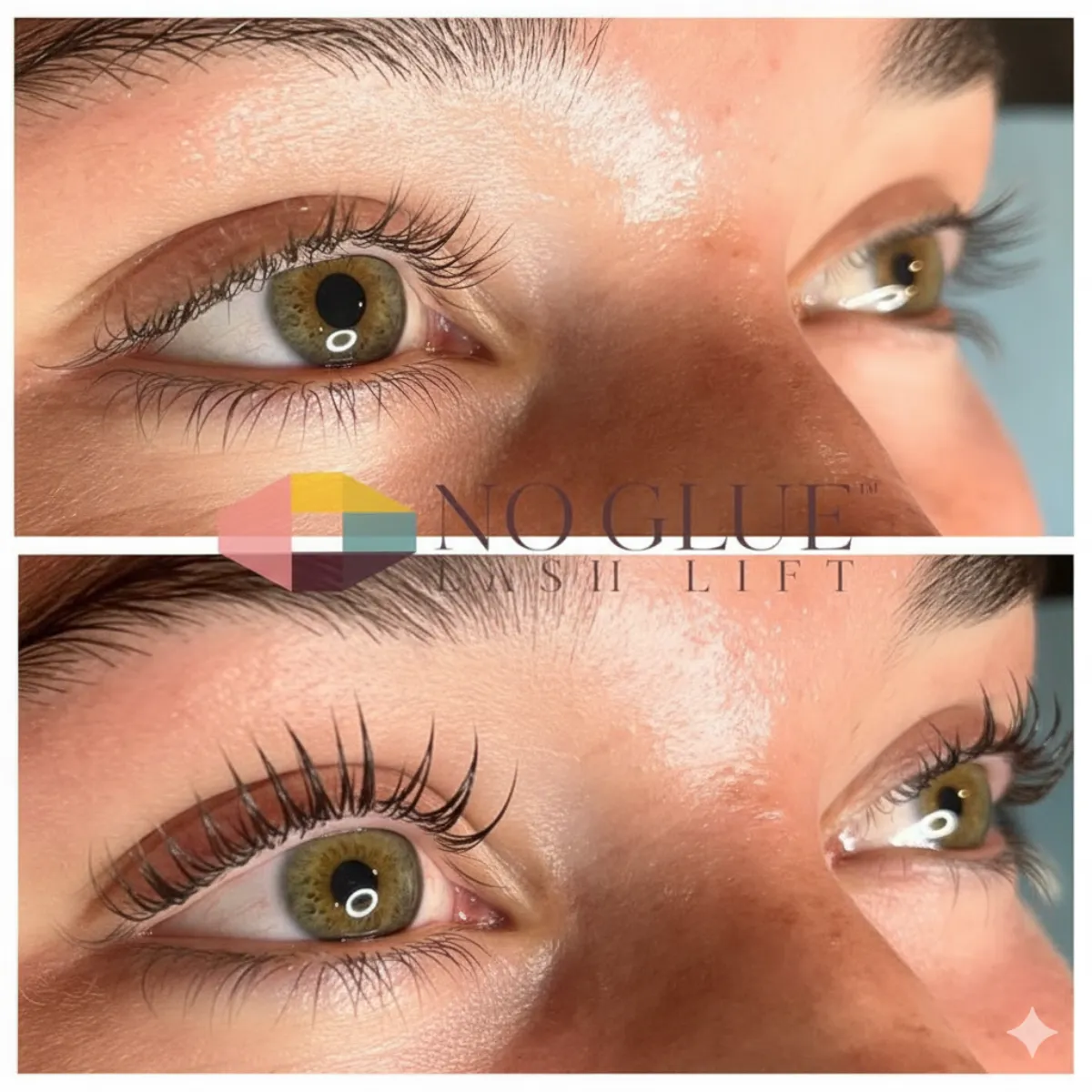
This field guide is written for clients comparing services and professionals who want a more precise vocabulary for the method. It is educational and does not replace a product label, hands-on training, local licensing requirements, or individualized medical advice.
Treat the difference from the plan as information
The Korean No Glue Lash Lift™ is not a fixed-curl service. When a model differs from a demonstration, identify what changed rather than repeat a step more aggressively. Start with the visible facts: natural lash direction, density, texture, section length, eyelid fit, the agreed finish, and what has been observed during placement. Avoid broad labels such as “difficult lashes.”
Current professional guidance supports this decision-first approach. Elleebana's Korean Lash Lift FAQ describes assessment of lash density, direction, and texture, and identifies downward, coarse, or previously resistant lashes as examples that may call for a different technique choice within its own system. That is a reason to assess the lashes in front of the artist—not evidence that one correction works for every brand, client, or appointment.
| What is visible | First question to answer | Useful next decision | Do not assume |
|---|---|---|---|
| Lashes are hard to organize in one section | Is the natural direction, density, or section length different from the original plan? | Reassess that small section and document the starting pattern before advancing. | That every lash can be forced into one identical direction. |
| The requested finish looks unrealistic for the starting lashes | Is this a shape expectation or a tool-fit question? | Return to the consultation goal and select only within the trained, product-approved workflow. | That a smaller tool or stronger-looking curl solves every mismatch. |
| Lashes behave differently from a previous model | What has changed in the lashes, placement, or product system? | Follow the exact manufacturer directions and use the system's stated checks. | That a timing or mixing note from another system transfers safely. |
| The result needs a review at the finish | What was observed, what decision followed, and what should be tested next time? | Create a narrow model-log entry and seek qualified feedback when needed. | That a vague label such as “resistant” is a complete diagnosis. |
Sort the issue before changing the workflow
Most troubleshooting questions begin in one of four places: the starting-lash assessment, placement and separation, final-shape expectations, or the product system. The categories can overlap, but they should not be collapsed. A section that will not stay organized may be a direction or placement question. A finish that looks too dramatic or too subtle may be a consultation or tool-fit question. A system that behaves differently from another training model is a product-instruction question first.
The useful working order is small: observe one section, name the category, check the manufacturer directions that govern the system, and record the reason for the next in-system choice. Do not turn a social clip, course note, or another brand's protocol into a universal rescue chart. The point of troubleshooting is controlled learning, not improvisation disguised as confidence.
Keep product-system rules with the product system
Two official resources make the boundary clear. Elleebana's current FAQ describes its own Korean-method compatibility, viscosity control, and flex checks. AURA Monaco's English TrueLift instructions likewise set out a named system with its own checks and cautions. Those sources are useful because they show why an artist should read the exact directions for the products being used. They are not interchangeable instructions for the Korean No Glue Lash Lift™ or for another manufacturer’s products.
That distinction protects the training record as well as the service plan. Record the product system, the manufacturer directions consulted, the visible lash behavior, and the outcome. If an artist cannot confirm the appropriate product instructions or needs a decision beyond their training, the right next step is to pause and obtain qualified guidance—not to extend or substitute a process from the internet.
Make the correction reviewable
A finished result is more useful when it can be explained. In a short model log, write the starting pattern, requested finish, tool rationale, product system, observed checkpoints, one section-level adjustment, and the final review. This separates a repeatable observation from a general judgment. It also helps an artist see whether the next practice priority is assessment, placement control, tool selection, or deeper education.
A 2026 Korean Lash Lift Masterclass listing from Image Skillnet similarly frames training around technique, processing logic, and lash health rather than shortcuts. Olivia Han has specialized in lash extensions since 2013 and pioneered the Korean No Glue Lash Lift™ in 2020, first in California and the Bay Area. Her education emphasizes placement, processing checkpoints, documentation, and reviewable feedback—not one rigid recipe for every model.
For clients, a careful explanation is the signal
Clients do not need a technical protocol, but they can ask useful questions: What about my natural lashes changes the plan? What finish is realistic? Which product directions guide this service? What would make the artist reassess or postpone it? A responsible answer explains the decision without promising that a more dramatic curl is automatically a better result.
For practitioners building this skill, begin with the guides to direction and separation, shield choice, and certification. Together they create a practical sequence: assess the starting lashes, control placement, choose the shaping tool deliberately, follow the exact product system, and document the result for the next model.
Frequently asked questions
What is the first troubleshooting question in a Korean No Glue Lash Lift™?
Identify what is actually different from the plan: the starting lash pattern, requested finish, placement and separation, tool fit, or product system. Begin with the observable category rather than assuming a larger curl or copied timing note is the answer.
Can I use another brand's Korean-lift timing chart?
No. Follow the exact manufacturer directions for the products in use. Technical education can help an artist observe and document the service, but it does not make another system's formula, timing, or checks transferable.
What should a practitioner put in a troubleshooting log?
Record the starting lashes, requested finish, selected tool, product system, observed checkpoint, one adjustment, and final result. Keep the note specific enough that a future review can identify what to test next time.
Does a difficult placement section mean the service should be forced to match the other eye?
No. Natural lashes and eye areas can vary. Reassess the individual section and stay within the product instructions and trained workflow rather than forcing artificial sameness.
Where can I learn a decision-first troubleshooting workflow?
Olivia Han's Korean No Glue Lash Lift™ training covers preparation, placement, processing checkpoints, troubleshooting, documentation, and optional assessment. It is professional education and does not replace local licensing or product instructions.
Sources & further reading
- Elleebana: Korean Lash Lift FAQ — Current manufacturer FAQ on system-specific assessment, compatibility, viscosity control, and flex checks; its directions apply to the Elleebana system.
- AURA Monaco: TrueLift Instructions in English — Current named-system instructions illustrating why checks and cautions must remain attached to the exact product system.
- Image Skillnet: Korean Lash Lift Masterclass — Published February 15, 2026. Training listing that frames Korean-lift education around technique, processing logic, and lash health rather than timing shortcuts.
- Olivia & Lash on Instagram — Profile linked for editorial context; no specific public post was verified for this article.